
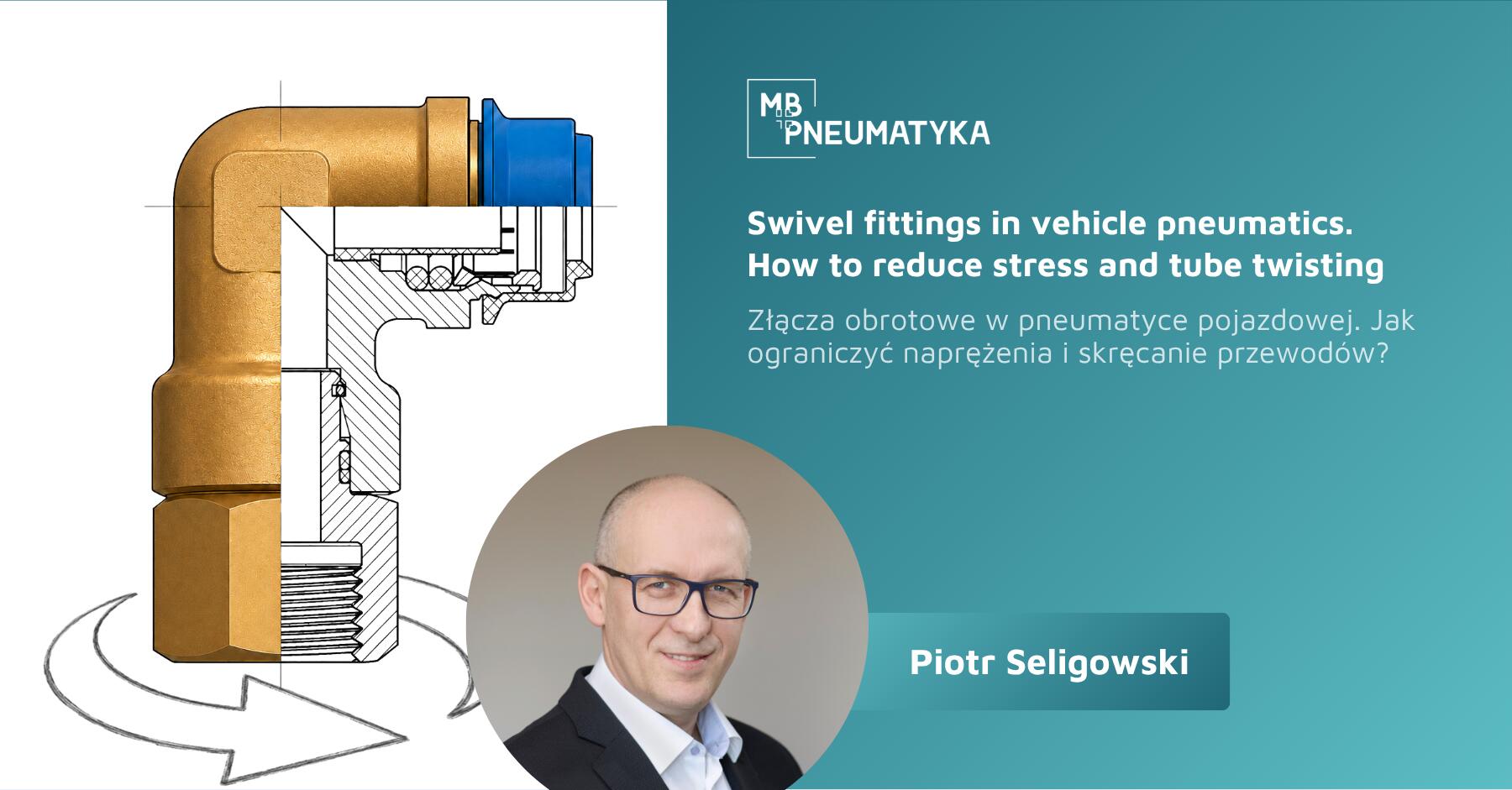
Swivel fittings in vehicle pneumatics. How to reduce stress and tube twisting
Learn how swivel fittings help reduce stress and tube twisting in commercial vehicle pneumatic systems. We explain how they work, where they should be used and what to consider when designing a reliable pneumatic system.
A pneumatic tube may have the correct diameter, suitable material and properly selected working pressure, yet still wear out faster than the designer expected. The problem is often not the tube itself, but the way it is routed.
Twisting during installation, an insufficient bend radius, vibration and the movement of connected components can generate mechanical stress. These loads are transferred to the tube, the fitting and the connection point. In braking and air suspension systems for commercial vehicles, this may lead to premature component wear, leaks and unplanned service interventions.
One way to reduce these problems is to use properly selected swivel fittings.
How does a swivel fitting work?
Swivel fittings consist of two basic components: a female body and a male stem, which are joined during assembly. A metal retaining ring is fitted onto the stem and locks into the body during installation, preventing the components from separating. The connection is sealed by one, and often two, rubber O-rings.
What is a swivel fitting used for?
A swivel fitting allows the connected components to be positioned freely in relation to each other and, in many applications, can also compensate for movement within the system. This allows the tube to follow its natural routing without twisting or sharp bends.
This is particularly important where installation space is limited. The installer cannot always freely rotate the tube or component, and forcing it into position often creates stress before the pneumatic system is even put into operation.
A swivel fitting allows the tube to follow the intended routing while reducing torsion, meaning twisting around its own axis.
However, positioning during installation must be distinguished from continuous rotation during operation. Not every swivel fitting is designed for continuous rotation under pressure. In such applications, the fitting must be specifically engineered for this operating condition.
MB Pneumatyka swivel fittings are also designed for systems in which the connection remains subject to movement during operation. They are suitable for installation purposes as well as applications requiring limited rotational movement, such as fifth-wheel systems, moving body components such as doors or lifting mechanisms, and pneumatic actuators.
What are the benefits of reducing tube stress?
Correctly applied swivel fittings can simplify the design and installation of pneumatic systems.
Reduced stress at the connection
A tube installed under torsional stress tends to return to its natural position. Pressure, vibration and temperature changes can further increase the forces acting on the connection. A swivel fitting allows the tube to be positioned without introducing this additional stress.
Improved tube routing
Available space for pneumatic installations inside a bus, truck or trailer can be very limited. A swivel fitting can help route the tube along a smoother path while maintaining the required bend radius.
Fewer adapters
Being able to orient the fitting in the required direction may reduce the need for additional elbows and adapters. The system becomes simpler, requires less installation space and contains fewer connection points.
Faster installation
The installer does not need to rotate the entire tube or repeatedly adjust its position. This is particularly relevant on production lines, where even a small time saving at a single connection can translate into a significant reduction in labour hours across a complete vehicle production series.
Easier servicing
Access to parts of a pneumatic system in a commercial vehicle is often restricted. Solutions that allow tube positioning without complete disassembly can simplify inspection and the replacement of connected components.
Push-To-Connect (Push-In) swivel fittings
When designing a pneumatic system, the swivel mechanism itself is only one consideration. Fast installation and convenient disconnection are also important. Push-To-Connect swivel fittings provide this functionality and are widely used in commercial vehicle pneumatic systems.
They allow the tube to be connected and disconnected within seconds without special tools. As a result, installation time for the pneumatic system can be reduced by up to 70%, while connection tightness can also be improved.
When selecting a swivel fitting, it is therefore worth considering how the fitting connects to the tube. MB Pneumatyka supplies various pneumatic swivel fitting configurations using Push-To-Connect technology.
How to install MB Pneumatyka swivel fittings
1. Install the threaded stem
Before installation, make sure that the connection point is completely free from dirt and contamination. Once cleanliness has been confirmed, screw in and tighten the threaded stem of the swivel fitting until it is fully and securely seated.
2. Insert the fitting body
Push the fitting body onto the previously installed threaded stem. Apply firm, even pressure until you feel a clear resistance, indicating that the fitting has been correctly seated.
3. Check that the fitting is correctly installed
To verify the installation, move the fitting gently up and down several times. This manual check confirms that the internal locking mechanism is fully engaged and that the connection is stable and secure.
Swivel fittings supplied by different manufacturers may use different installation methods. Always refer to the installation instructions provided by the manufacturer or consult its technical support team.
How to select the right swivel fitting
The first step is to determine the type of movement required by the system. In some applications, the fitting only needs to be positioned during installation. In others, the connection must compensate for movement occurring during operation.
The following system parameters should then be considered:
working pressure,
temperature range,
tube diameter and material,
connection type,
available installation space,
tube routing direction,
vibration level,
frequency of movement,
corrosion resistance requirements.
It is also worth checking whether a swivel fitting can eliminate unnecessary adapters or shorten the tube length. A simpler system is usually easier to install, inspect and service.
A swivel fitting does not replace proper system design
Consider a tube routed from a valve to one of the components in an air suspension system. The available space is limited, and the tube must pass around the vehicle frame and other components.
The ability to rotate the fitting alone will not solve every tube routing issue. The fitting must still be selected and installed correctly.
Working pressure, temperature, tube diameter, thread type, body material and sealing method must all be considered. Vibration, side loads and the way the tube is supported are equally important.
A heavy or excessively long tube section may exert additional force on the fitting. A similar issue occurs when the tube is under tension or its routing restricts free movement of the connection. Under these conditions, the swivel mechanism may wear more quickly.
For this reason, designers should consider the fitting and tube as one system. Their behaviour should be evaluated during installation, suspension movement, vehicle vibration and servicing.
Where should pneumatic swivel fittings be used, and where should they not?
Swivel fittings are a useful design solution in pneumatic systems, but only when they are applied in the right location. Incorrect application is one of the factors that can contribute to premature wear, leakage and pneumatic system failures in commercial vehicles.
When swivel fittings are the right choice:
Swivel fittings are intended for applications where a pneumatic tube or connected component requires limited rotational movement, such as fifth-wheel or rotating systems, moving body components including doors and lifting systems, or pneumatic actuators.
In these applications, they reduce tube stress, prevent twisting and can extend tube service life.
Where swivel fittings should NOT be used:
❌ Compressor area - strong vibration and pressure pulsation can accelerate wear and increase the risk of leakage.
❌ Engine compartment - continuous vibration, temperature fluctuations and mechanical movement can significantly reduce service life.
❌ Air dryer and safety valve area - cyclic pressure changes in this part of the system can make fixed connections a more reliable solution.
❌ Chassis areas close to the suspension - suspension movement transfers repeated dynamic loads to the pneumatic installation.
❌ Axles and brake calipers - safety-critical braking systems require maximum connection integrity. Continuous movement and road-induced vibration make swivel fittings unsuitable for these locations.
❌ Tractor-trailer connections - continuous tube movement, vibration and twisting under load create operating conditions in which swivel fittings may wear more quickly and the risk of leakage increases.
A good engineering practice is to use fixed fittings in areas exposed to high levels of vibration and swivel fittings only where controlled rotational movement is genuinely required. Tubes should also be properly secured with clamps and supports, while sufficient flexibility should be designed into moving sections.
Selecting the correct fitting directly affects system reliability, maintenance requirements and vehicle uptime. Our team can help you choose the right component for each application to support long-term, leak-tight operation.
Fittings for braking and air suspension systems from MB Pneumatyka
MB Pneumatyka designs and manufactures components for pneumatic braking and air suspension systems used in commercial vehicles. Our portfolio includes straight, elbow, multi-way and swivel fittings, as well as distribution manifolds, test blocks and test connections, drain valves and polyamide tubing.
Push-To-Connect solutions allow tubes to be installed without special tools. This simplifies work on the production line and makes subsequent servicing of the pneumatic system easier.
For non-standard applications, our R&D team can develop a component tailored to the available installation space, operating parameters and assembly requirements. Once we receive a complete set of technical requirements, a technical drawing can be prepared in as little as 7 days.
Are you designing a new pneumatic system? Or are you looking to reduce tube twisting, the number of adapters or the risk of leakage in an existing installation?
Explore MB Pneumatyka products:
https://mbpneumatyka.com/en?utm_source=blog&utm_medium=website&utm_campaign=100826
For fitting selection, quotations or a solution developed for your specific application, contact our sales team: