
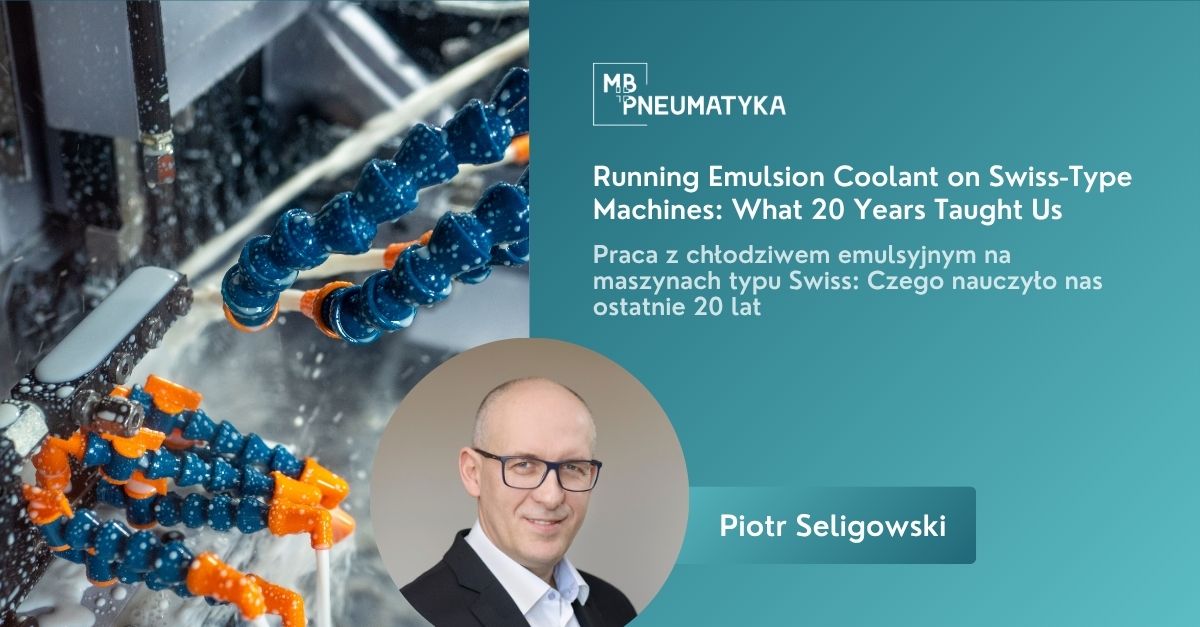
Running Emulsion Coolant on Swiss-Type Machines: What 20 Years Taught Us
Swiss-type lathes are usually associated with oil. That is what most manufacturers recommend, and for good reason: oil works well at high spindle speeds, protects the guide bush and sliding components, and helps keep thermal behaviour stable.
We went a different route.
In 2004, when we bought our first Swiss-type machine, a Star SR-20 R II, our production floor was already built around emulsion coolant. Our DMG turret lathes were running on coolant, and adding oil meant creating a second system: separate storage, separate maintenance, separate disposal, and another set of procedures for the team.
So we made a decision to stay with emulsion and adjust the process around it.
From one machine to eighteen
What started as a controlled choice is now standard practice in our facility. Today, 18 Swiss-type machines from Star, Citizen, and Tsugami run on emulsion, alongside our DMG MORI, OKUMA, and FANUC machines.
In other words, the entire machining area works with one coolant system. Swiss-type machines can run effectively on emulsion. But it is not a simple one-to-one replacement for oil. You need the right technical setup, and you need the discipline to keep that setup under control every week.
When coolant became a real cost factor
For the first few years, coolant consumption was not a major topic. The machine park was smaller, volumes were manageable, and the system did not need much financial scrutiny.
That changed in 2016. As the number of Swiss-type machines increased, coolant volumes increased with them. At that point, the cost was no longer something to accept in the background. We needed to look at it properly.
So we tested four coolant suppliers and compared them against five practical criteria:
coolant carryout in chips leaving the machining zone,
cleanliness inside the machining chamber,
impact on downstream part washing,
surface quality on finished parts, including possible discolouration on brass,
purchase cost per litre.
After the tests, we selected the product that gave us the best overall result for the way we actually produce parts.
The part you cannot neglect: concentration control
We mainly machine brass, which does not put extreme demands on coolant lubrication. The bigger concern is machine protection.
The parts themselves tolerate contact with coolant well.
The machine components are a different story. Guide bush housings, spindle bearings, and precision slideways need stable protection over time.
That is why concentration control is the most important variable in our system.
Our standard approach is simple:
minimum working concentration: 5%,
central mixing system with an automatic dispenser,
weekly concentration checks by the maintenance team,
ongoing parameter adjustment across all machines.
This is not complicated, but it has to be done consistently. That routine is what keeps 18 machines running across shifts without corrosion-related issues or avoidable downtime.
Recovering coolant instead of losing it with chips
At this scale, coolant volume has to be managed seriously. Chips and coolant leave the machining zone together, then pass through an industrial centrifuge. The coolant is separated, recovered, and returned to the system. As a result, the coolant content in outgoing chips stays below 2%.
That makes a real difference. We reduce coolant consumption, lower disposal costs, and limit the environmental impact of the machining process.
The next step: better filtration
We are now implementing a coolant filtration system to extend fluid service life and improve process stability even further.
Longer coolant cycles mean fewer batch top-ups, more stable concentrations, and less variation in surface quality between production runs.
This is still not a finished chapter. We are still continuing to improve our processes over time.
One detail to settle before ordering a machine
If you are planning to buy a new Swiss-type machine and want to run it on emulsion instead of oil, tell the manufacturer at the order stage. That matters.
The manufacturer can add protective elements for coolant-sensitive components during the build. Retrofitting that protection after delivery is usually possible, but it is much more expensive.
It is a small point in the specification phase. But it becomes a much bigger issue once the machine is already on the floor.
Precision starts before the spindle turns
Coolant management is only one part of the process, but it says a lot about how we approach machining in general. The same level of control applies from raw material selection to final leak testing of the finished component.
If you are sourcing precision pneumatic components for commercial vehicle applications, our technical team can review your requirements and discuss the right production approach.